

Did you know Georgia is home to one of the world’s oldest wine regions, with evidence of winemaking dating back over 8,000 years? This small but mighty Caucasus nation offers an intoxicating blend of dramatic mountain landscapes, ancient Christian heritage, world-class cuisine, and legendary hospitality that has captivated travelers for centuries. Situated at the crossroads of Europe and Asia, Georgia delivers an authentic travel experience that feels both exotic and welcoming – all without the crowds or high prices of more mainstream destinations.
Getting There & Planning Your Journey
Georgia is becoming increasingly accessible for international travelers, with several major airlines now offering direct flights to its three international airports. Planning your journey to this Caucasus gem requires some preparation, but the rewards are well worth it.
International Airports
- Tbilisi International Airport (TBS) – The main gateway, located 17 km (10.5 miles) southeast of the capital. Serves flights from major European cities, the Middle East, and Central Asia.
- Kutaisi International Airport (KUT) – Georgia’s second-largest airport, located 20 km (12.4 miles) west of Kutaisi. Budget carrier Wizz Air operates numerous routes here from European destinations.
- Batumi International Airport (BUS) – Seasonal airport on the Black Sea coast with connections to Turkey, Ukraine, and several European cities during summer months.
Entry Requirements
Georgia offers one of the world’s most generous visa policies. Citizens from 98+ countries (including the EU, UK, US, Canada, and Australia) can enter visa-free for up to one year. This policy even allows visitors to work, open bank accounts, and conduct business during their stay.
For those requiring a visa, e-visas can be obtained online before arrival. Your passport should be valid for the duration of your intended stay.
Travel Insurance
While Georgia is generally safe, comprehensive travel insurance is highly recommended, especially if you plan to hike in remote areas or participate in adventure activities. Ensure your policy covers medical evacuation from mountainous regions and check if any special coverage is needed for regions like Abkhazia (which most standard policies exclude).
Pro Tip: When booking flights to Georgia, consider Turkish Airlines or Qatar Airways, which often offer the most convenient connections through Istanbul or Doha. If you’re on a budget, Wizz Air flies to Kutaisi from numerous European cities at very competitive prices.

Best Time to Visit Georgia
Georgia experiences distinct seasons, each offering a unique perspective on the country. Your ideal time to visit depends largely on your planned activities and the regions you wish to explore.
| Season | Months | Advantages | Considerations | Best For |
| Spring | Late April – June | Mild temperatures, wildflowers in bloom, fewer tourists | May can be rainy in Tbilisi | Hiking, wine tours, cultural exploration |
| Summer | July – August | Mountain passes open, long daylight hours | Hot in cities (30-35°C/86-95°F), crowded at Black Sea | High-altitude trekking, beach holidays |
| Autumn | September – October | Wine harvest festivals, pleasant temperatures, fall colors | Mountain weather becomes unpredictable by late October | Wine tourism, photography, city exploration |
| Winter | November – March | Ski season, Christmas celebrations, fewer tourists | Some mountain roads closed, shorter daylight hours | Skiing, urban exploration, budget travel |
Recommended Months to Visit
The sweet spots for visiting Georgia are May-June and September-October. During these periods, you’ll enjoy pleasant temperatures, avoid the summer crowds, and have access to most regions and activities. The autumn wine harvest (rtveli) in September is particularly special, offering a glimpse into Georgia’s ancient winemaking traditions.
Months to Avoid
If possible, avoid July and August in Tbilisi and Batumi, when temperatures soar and tourist numbers peak. November can be dreary with rain and the transition to winter, while January-February limits access to mountain regions unless you’re specifically coming for winter sports.
Weather Note: Mountain weather in Georgia can change rapidly regardless of season. If hiking in regions like Kazbegi or Svaneti, always check local forecasts and be prepared for sudden temperature drops or precipitation.

Getting Around Locally
Georgia’s compact size makes it relatively easy to explore, though transportation infrastructure varies significantly between urban and rural areas. Understanding your options will help you navigate the country efficiently.
Marshrutkas (Minivans)
These shared minivans are the backbone of Georgia’s public transportation system. They connect virtually every town and village, operating on semi-fixed schedules (they typically depart when full). Marshrutkas are incredibly affordable – a 3-hour journey from Tbilisi to Kazbegi costs around 10 GEL ($3.75 USD).
While economical, they can be crowded and uncomfortable for longer journeys. Drivers sometimes take mountain roads at alarming speeds, so choose your routes carefully if you’re safety-conscious.
Trains
Georgia’s rail network connects major cities, with modern high-speed trains operating between Tbilisi and Batumi. The overnight sleeper train on this route is particularly comfortable and scenic. Tickets are affordable (20-30 GEL/$7.50-11.25 USD for second class) and can be purchased online through the Georgian Railway website or at stations.
The railway system doesn’t reach mountain regions, so you’ll need to combine train travel with other transportation methods for a comprehensive tour.
Taxis & Ride-Sharing
Taxis are plentiful in cities and remarkably affordable. In Tbilisi, most short rides cost 5-10 GEL ($1.90-3.75 USD). Always use metered taxis or negotiate the fare before departure. The Bolt app works throughout major Georgian cities and is highly recommended for hassle-free rides.
For intercity travel, services like GoTrip allow you to book private transfers with the flexibility to make stops along scenic routes – ideal for exploring remote areas.
City Public Transport
Tbilisi has a clean, efficient metro system with two lines covering major areas of the city. Single journeys cost just 1 GEL ($0.37 USD). The capital and other major cities also have extensive bus networks. Purchase a rechargeable card (2 GEL/$0.75 USD) at metro stations or bus terminals for all public transport in Tbilisi.
Car Rental
Renting a car gives you maximum flexibility, especially for exploring remote regions. International agencies operate in major cities, but local companies offer better rates (from $25-35 USD per day). Georgian driving can be chaotic by Western standards, and mountain roads require confidence and experience. An International Driving Permit is recommended alongside your regular license.
Road Safety Alert: Road conditions vary dramatically in Georgia. While highways between major cities are generally good, rural and mountain roads can be poorly maintained with limited guardrails on steep drops. Night driving outside cities is not recommended.

Where to Stay
Georgia offers accommodations to suit every budget and travel style, from luxury hotels in Tbilisi to family-run guesthouses in mountain villages. The country’s legendary hospitality shines brightest in its accommodation options.
Tbilisi Accommodations
Georgia’s capital offers the widest range of places to stay:
- Luxury: Five-star international brands like Marriott and Radisson Blu cluster around Freedom Square and Rustaveli Avenue, with rooms from $150-250 USD per night.
- Boutique Hotels: The Old Town and Vera neighborhoods feature characterful boutique properties in renovated historic buildings, often with stunning balconies and courtyards ($70-150 USD).
- Mid-Range: Comfortable hotels and apartments throughout central districts offer excellent value at $40-70 USD per night.
- Budget: Hostels in the Marjanishvili area and near Fabrika cultural center provide dorm beds from $8-15 USD and private rooms from $25-40 USD.
Regional Accommodations
Outside the capital, your options include:
- Wine Chateaus: In Kakheti wine region, stay at vineyard estates that combine accommodation with wine tastings and tours ($80-200 USD).
- Mountain Lodges: Kazbegi and Mestia feature alpine-style lodges with stunning views, ranging from basic to luxurious ($40-150 USD).
- Seaside Resorts: Batumi offers everything from international high-rises to smaller beach hotels, with summer prices from $50-200 USD.
- Family Guesthouses: Throughout rural Georgia, family-run guesthouses provide authentic experiences with home-cooked meals included ($20-40 USD per person).
Unique Stays
For memorable accommodation experiences, consider:
- Traditional Svan Towers: Some towers in Svaneti have been converted into basic but atmospheric guest accommodations.
- Qvevri Cottages: In wine regions, stay in cottages shaped like the traditional clay vessels used for winemaking.
- Former Sanatoriums: Soviet-era spa resorts in Tskaltubo have been reimagined as unique hotels.
- Monastery Cells: Some monasteries offer simple rooms for pilgrims and travelers seeking spiritual experiences.
Booking Tip: While major booking platforms cover most Georgian accommodations, many family guesthouses in smaller towns and villages aren’t listed online. In these locations, you can often find excellent value by asking locally upon arrival or through your previous accommodation’s recommendations.

Dining & Local Cuisine
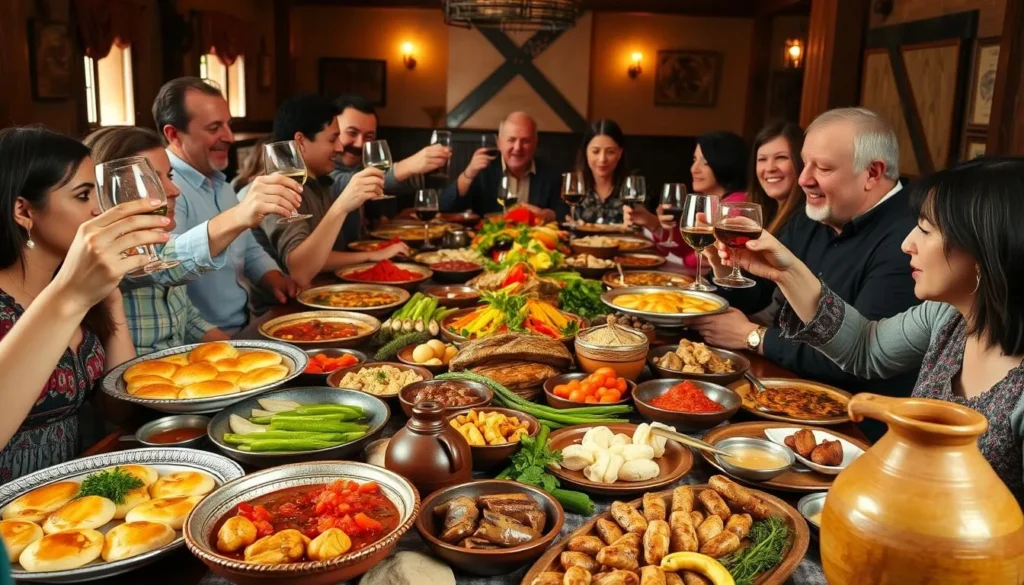
Georgian cuisine ranks among the world’s most underrated culinary treasures, with a rich tapestry of flavors developed over centuries at the crossroads of Europe and Asia. Meals are central to Georgian culture, and the traditional feast (supra) is an experience not to be missed.
Must-Try Georgian Dishes
- Khachapuri: Cheese-filled bread that comes in regional variations. The boat-shaped Adjaruli khachapuri with its egg and butter topping is the most famous.
- Khinkali: Soup dumplings filled with spiced meat, cheese, or mushrooms. Eat them by hand using the doughy “handle” (which traditionally isn’t eaten).
- Mtsvadi: Marinated meat skewers grilled over grape vine cuttings.
- Pkhali: Vegetable pâtés made with walnuts, herbs, and spices. Typically served as a spread with bread.
- Lobio: Seasoned bean stew served in a clay pot with mchadi (cornbread).
- Churchkhela: String-shaped candy made from grape juice and nuts, often called “Georgian Snickers.”
Regional Specialties
- Kakheti: Mtsvadi (grilled meat) and simple, hearty dishes that pair with local wines.
- Samegrelo: Spicier dishes including gebzhalia (cheese rolls in mint sauce) and kharcho (walnut soup).
- Adjara: Seafood dishes and the famous Adjaruli khachapuri.
- Svaneti: Kubdari (meat-filled bread) and dishes seasoned with Svaneti salt (a blend of salt and spices).
- Racha: Lobio (bean stew) and shkmeruli (garlic chicken).
Georgian Wine
As the world’s oldest winemaking country, Georgia’s 8,000-year tradition produces unique wines using the qvevri method – fermenting in clay vessels buried underground. Key wine regions include:
- Kakheti: Georgia’s primary wine region, producing 70% of the country’s wine, including excellent Saperavi (red) and Rkatsiteli (white) varieties.
- Kartli: Known for lighter, crisper wines than Kakheti.
- Imereti: Produces distinctive wines with less skin contact than traditional Kakhetian methods.
Don’t miss trying amber (orange) wines – white wines made with extended skin contact that Georgia pioneered thousands of years before they became trendy in Western countries.
Dining Etiquette
Georgian meals are communal affairs with shared dishes. When invited to a supra (feast), expect multiple courses, abundant toasts, and possibly hours at the table. The tamada (toastmaster) directs the proceedings with eloquent toasts that guests are expected to honor by drinking.
In restaurants, service can be unhurried by Western standards. Tipping around 10% is becoming common in tourist areas, though it’s not traditionally expected.
Vegetarian Note: While meat features prominently in Georgian cuisine, the Orthodox fasting tradition has created many delicious vegetarian dishes. Look for lobio (beans), pkhali (vegetable pâtés), ajapsandali (ratatouille), and meat-free versions of khachapuri.
Attractions, Sightseeing & Activities
Georgia packs an astonishing variety of attractions into its compact territory. From ancient cave cities to snow-capped mountains and subtropical coastlines, the country offers experiences to satisfy every type of traveler.
Tbilisi Highlights
- Old Town (Dzveli Tbilisi): Wander through narrow lanes with wooden balconies, sulfur bathhouses, and ancient churches.
- Narikala Fortress: Climb to this 4th-century citadel for panoramic city views.
- Abanotubani: Visit the iconic domed sulfur baths where Pushkin once bathed.
- Peace Bridge: Cross this contemporary glass-and-steel pedestrian bridge illuminated with thousands of LEDs.
- Dry Bridge Market: Hunt for Soviet memorabilia and unique souvenirs at this open-air flea market.
Day Trips from Tbilisi
- Mtskheta: Explore Georgia’s ancient capital and spiritual heart, home to UNESCO-listed Svetitskhoveli Cathedral and Jvari Monastery (30 minutes from Tbilisi).
- David Gareja: Visit this remarkable 6th-century cave monastery complex straddling the Azerbaijan border (2.5 hours from Tbilisi).
- Gori & Uplistsikhe: See Stalin’s birthplace museum and the ancient rock-hewn city nearby (1.5 hours from Tbilisi).
- Sighnaghi: Explore this picturesque “City of Love” in the heart of wine country (2 hours from Tbilisi).
Must-Visit Regions
- Kazbegi: Marvel at the iconic Gergeti Trinity Church set against Mt. Kazbek (5,047 m/16,558 ft).
- Svaneti: Discover medieval tower-houses and spectacular mountain scenery in Europe’s highest inhabited region.
- Kakheti: Tour Georgia’s premier wine region with ancient monasteries and traditional wine cellars.
- Adjara: Enjoy the subtropical Black Sea coast and the vibrant city of Batumi.
Hidden Gems
Beyond the well-trodden tourist path, consider these lesser-known treasures:
- Vardzia: Explore this remarkable 12th-century cave city carved into a cliff face.
- Tusheti: Trek through one of Georgia’s most remote and beautiful mountain regions (accessible only in summer).
- Racha: Discover pristine forests, alpine meadows, and distinctive wines in this under-visited region.
- Lagodekhi Protected Areas: Hike through diverse ecosystems from semi-desert to alpine zones.
- Chiatura: Ride Soviet-era cable cars in this unusual mining town.

Museums, Cultural Spots & Festivals
Georgia’s rich cultural heritage spans millennia, from ancient pagan rituals to early Christian traditions and Soviet-era influences. The country’s museums, religious sites, and vibrant festivals offer fascinating windows into this diverse cultural landscape.
Top Museums
- Georgian National Museum (Tbilisi): Houses the country’s greatest archaeological treasures, including the world’s oldest discovered textiles and gold artifacts dating back to the 3rd millennium BCE.
- Museum of Fine Arts (Tbilisi): Showcases medieval Christian icons, crosses, and jewelry, plus works by renowned Georgian painter Niko Pirosmani.
- Stalin Museum (Gori): A fascinating if uncritical look at the Soviet dictator in his hometown, including his preserved birth house and personal railway carriage.
- Svaneti Museum of History and Ethnography (Mestia): Displays exceptional medieval icons and manuscripts from this remote mountain region.
- Open Air Museum of Ethnography (Tbilisi): Features traditional architecture from Georgia’s diverse regions.
Religious Heritage
Georgia adopted Christianity in 326 CE, making it one of the world’s oldest Christian nations. Its religious sites include:
- Svetitskhoveli Cathedral (Mtskheta): An 11th-century UNESCO World Heritage site said to contain Christ’s mantle.
- Gelati Monastery (near Kutaisi): A medieval academic complex with stunning frescoes.
- Jvari Monastery (Mtskheta): A 6th-century church perched dramatically above the confluence of two rivers.
- Alaverdi Monastery (Kakheti): An imposing 11th-century cathedral surrounded by vineyards.
- Anchiskhati Basilica (Tbilisi): The oldest surviving church in the capital (6th century).
Major Festivals
Time your visit to coincide with these cultural celebrations:
- Tbilisoba (October): The capital’s biggest festival celebrates the city’s diversity with music, dance, food, and wine.
- Rtveli (September-October): The traditional grape harvest is celebrated throughout wine regions with feasting and folk traditions.
- Orthodox Easter: Georgia’s most important religious holiday features candlelit processions and special foods.
- Art Gene (July): A celebration of traditional Georgian music, dance, and crafts from different regions.
- Tushetoba (August): A festival celebrating the culture of the remote Tusheti mountain region.
- New Wine Festival (May): Showcases the first wines of the season in Tbilisi.
Traditional Arts & Crafts
Look for these distinctive Georgian crafts as souvenirs:
- Cloisonné Enamel: Intricate jewelry and decorative items using a traditional technique dating back to medieval times.
- Felt: Handmade wool products including hats, slippers, and decorative items.
- Ceramics: Traditional pottery including wine vessels and decorative items.
- Carpets: Distinctive patterns from different regions, particularly Tusheti and Kakheti.
- Chokha: The traditional male costume with its distinctive cartridge holders across the chest.
Cultural Tip: Georgian polyphonic singing is recognized by UNESCO as an Intangible Cultural Heritage. Try to catch a performance at a restaurant or cultural venue – the complex harmonies and ancient melodies are unforgettable.

Sports, Nature & Outdoor Experiences
Georgia’s diverse landscapes offer exceptional opportunities for outdoor adventures, from high-altitude trekking to Black Sea water sports. The country’s relatively undiscovered natural areas provide experiences that rival more famous European destinations – often at a fraction of the cost and crowd levels.
Hiking & Trekking
Georgia’s mountain regions offer world-class hiking opportunities:
- Mestia to Ushguli Trek: This 4-day journey through Svaneti passes medieval villages and stunning glaciers.
- Kazbegi Day Hikes: Trails around Stepantsminda include the popular route to Gergeti Trinity Church and more challenging treks to glaciers.
- Tusheti Routes: Remote trails through one of Georgia’s most pristine regions, accessible only in summer.
- Borjomi-Kharagauli National Park: Well-marked trails through diverse ecosystems with camping facilities.
Winter Sports
Georgia’s affordable ski resorts are gaining international recognition:
- Gudauri: The largest resort with 70 km (43 miles) of runs at elevations between 2,000-3,300 m (6,560-10,830 ft).
- Bakuriani: A family-friendly resort that hosted the 2023 FIS Freestyle Ski and Snowboarding Championships.
- Goderdzi: A newer resort in Adjara with excellent powder conditions.
- Tetnuldi: Developing resort in Svaneti with spectacular mountain views.
Water Activities
From the Black Sea coast to mountain rivers:
- Rafting: The Aragvi and Mtkvari rivers offer exciting white-water experiences for various skill levels.
- Black Sea: Swimming, kayaking, and paddleboarding along the coast near Batumi and Kobuleti.
- Paragliding: Tandem flights available in Gudauri and above Tbilisi.
- Canyoning: Explore the dramatic Martvili Canyon by boat or the Okatse Canyon via suspended walkways.
Natural Wonders
Don’t miss these remarkable natural sites:
- Prometheus Cave: Explore this massive karst cave system with underground rivers and dramatic lighting.
- Sataplia Nature Reserve: Walk alongside dinosaur footprints and through prehistoric caves.
- Lagodekhi Protected Areas: Georgia’s oldest nature reserve with diverse ecosystems from semi-desert to alpine zones.
- Dashbashi Canyon: Features a spectacular glass bridge suspended 280 m (920 ft) above the canyon floor.
- Paravani Lake: Georgia’s largest lake at 3,700 hectares (9,143 acres), popular for fishing and bird watching.
Hot Springs & Spas
Georgia’s natural thermal waters have attracted visitors since ancient times:
- Tbilisi Sulfur Baths: Historic bathhouses in the capital’s Abanotubani district.
- Borjomi: Famous mineral waters with supposed healing properties.
- Tskaltubo: Soviet-era spa town where Stalin once took the waters.
- Nunisi: Remote hot springs in a forest setting.
Mountain Safety: Georgia’s mountain regions are beautiful but can be dangerous for unprepared visitors. Always check weather forecasts, inform others of your route, carry appropriate gear, and consider hiring a local guide for more challenging treks.

Safety, Etiquette & Local Customs
Georgia is generally a safe and welcoming destination for travelers, but understanding local customs and etiquette will enhance your experience and help you navigate cultural differences with respect and awareness.
Safety Considerations
- General Safety: Georgia has low crime rates, and violent crime against tourists is extremely rare. Exercise normal precautions regarding personal belongings in crowded areas.
- Road Safety: This is perhaps the biggest risk to visitors. Driving standards can be erratic, and mountain roads often lack guardrails. Consider professional drivers for mountain regions.
- Political Situation: The occupied territories of Abkhazia and South Ossetia remain off-limits to visitors entering from Georgia. Avoid political demonstrations, which occasionally occur in Tbilisi.
- Mountain Safety: Weather can change rapidly in the Caucasus. Always be prepared with appropriate gear and inform others of your hiking plans.
Cultural Etiquette
- Greetings: Georgians typically greet with a handshake. Close friends may exchange kisses on the cheek.
- Hospitality: If invited to a Georgian home, bring a small gift (wine, sweets, or flowers). Refusing food or drink can be considered impolite – at least sample what’s offered.
- Toasting Culture: Georgian feasts (supras) involve numerous toasts led by a toastmaster (tamada). It’s respectful to at least sip during toasts, even if you’re not drinking alcohol.
- Religious Sites: When visiting churches, women should cover their heads and wear skirts that cover the knees (wraps are usually provided). Men should remove hats and wear long pants.
Local Customs
- Georgian Time: Georgians often have a relaxed attitude toward punctuality. Service in restaurants can be unhurried by Western standards.
- Bread Respect: Bread is considered sacred. If you drop it, tradition says to pick it up, kiss it, and touch it to your forehead.
- Photography: Ask permission before photographing people, especially in rural areas. Some churches restrict or charge for interior photography.
- Tipping: Not traditionally expected but becoming more common in tourist areas. 10% is appropriate in restaurants if service charge isn’t included.
- LGBTQ+ Travelers: Georgia remains conservative regarding LGBTQ+ issues. Discretion is advised, particularly outside Tbilisi.
Language Basics
While many younger Georgians and those in the tourism industry speak English, learning a few Georgian phrases will be greatly appreciated:
- Gamarjoba (gah-mar-jo-bah) – Hello
- Gmadlobt (g-mad-lobt) – Thank you
- Tu sheidzleba (too sheh-ee-dzleh-bah) – Please
- Nakhvamdis (nakh-vam-dees) – Goodbye
- Gaumarjos! (gau-mar-jos) – Cheers! (during toasts)
Cultural Note: Georgia uses its own unique alphabet that’s unlike any other writing system. While most signs in tourist areas include Latin script, it can be helpful to learn to recognize a few key words in Georgian script for navigation purposes.

Additional Nearby Destinations
Georgia’s strategic location makes it an excellent base for exploring the broader Caucasus region and neighboring countries. Consider extending your journey to these nearby destinations.
Armenia
Just south of Georgia, Armenia offers an equally rich cultural heritage with its own distinctive character:
- Distance: Yerevan is 280 km (174 miles) from Tbilisi, approximately 5-6 hours by road or overnight train.
- Highlights: Ancient monasteries including UNESCO-listed Geghard and Haghpat, Lake Sevan, the stunning landscapes of Dilijan National Park, and the vibrant capital of Yerevan.
- Practical Info: Most nationalities can enter visa-free. The Georgian-Armenian border at Sadakhlo/Bagratashen is straightforward to cross.
Azerbaijan
Completing the trio of Caucasus nations, Azerbaijan blends East and West with its unique cultural identity:
- Distance: Baku is 550 km (342 miles) from Tbilisi, approximately 8-9 hours by road or overnight train.
- Highlights: The ultramodern architecture of Baku contrasted with its UNESCO-listed Old City, the mud volcanoes of Gobustan, and the mountain village of Sheki.
- Practical Info: Most visitors require an e-visa, which can be obtained online. The Georgian-Azerbaijani border at Red Bridge is commonly used.
Turkey
Georgia’s southwestern neighbor offers a completely different cultural experience:
- Distance: Trabzon is 250 km (155 miles) from Batumi, approximately 4-5 hours by road.
- Highlights: The Black Sea coast, historic Trabzon with the stunning Sumela Monastery, and the distinctive culture of Turkey’s northeastern regions.
- Practical Info: Many nationalities require an e-visa for Turkey. The Georgian-Turkish border at Sarpi is busy but efficient.
Multi-Country Itineraries
Popular combinations for extended Caucasus journeys include:
- Georgia & Armenia: A classic 2-3 week itinerary covering the highlights of both countries, connected by easy land transport.
- Caucasus Grand Tour: Georgia, Armenia, and Azerbaijan in 3-4 weeks for a comprehensive exploration of the region.
- Black Sea Route: Combine Georgia’s Adjara region with Turkey’s eastern Black Sea coast for a unique coastal journey.
Border Crossing Tip: When planning multi-country itineraries, remember that the borders between Armenia and Azerbaijan remain closed due to ongoing conflict. If visiting both countries, you’ll need to return through Georgia.

Practical Travel Tips
These insider tips will help you navigate Georgia smoothly and make the most of your visit to this fascinating country.
Money Matters
- Currency: The Georgian Lari (GEL) is the official currency. As of 2025, 1 USD ≈ 2.7 GEL.
- ATMs: Widely available in cities and towns. TBC and Bank of Georgia ATMs typically offer the best rates.
- Cards: Credit cards are widely accepted in cities but carry cash for rural areas and small businesses.
- Costs: Georgia remains very affordable by European standards. Budget travelers can manage on $30-40 USD per day, mid-range on $50-100 USD.
- Bargaining: Not common in shops but expected at markets and with taxi drivers (if not using apps).
Connectivity
- SIM Cards: Affordable and easy to obtain. Magti, Geocell, and Beeline are major providers with packages starting around 10 GEL ($3.70 USD) for ample data.
- Wi-Fi: Widely available in accommodations, restaurants, and cafes in urban areas. Quality varies in rural regions.
- Power: Georgia uses Type C and F sockets (European standard) with 220V supply.
- Apps: Download Bolt for taxis, Maps.me for offline navigation, and Georgian Railways for train tickets.
Health & Accessibility
- Drinking Water: Tap water is generally safe in cities but bottled water is recommended in rural areas.
- Pharmacies: Readily available and well-stocked. Many medications that require prescriptions elsewhere are available over-the-counter.
- Accessibility: Limited infrastructure for travelers with mobility challenges, particularly in historic areas and rural regions.
- Altitude: Mountain regions like Kazbegi and Svaneti sit at elevations where altitude sickness can affect some visitors. Acclimatize gradually.
Packing Essentials
- Modest Clothing: For visiting churches (women need head coverings and skirts/pants below the knee; men need long pants).
- Comfortable Footwear: Even city exploration involves cobblestones and hills.
- Layers: Weather can change rapidly, especially in mountain regions.
- Medications: Bring any prescription medications you need, though pharmacies are well-stocked.
- Power Adapter: European-style plug (Type C/F).
Local Insights
- Georgian Timing: Restaurants often don’t fill up until 9-10 PM, and nightlife starts late.
- Wine Tastings: Small family wineries often offer more authentic experiences than commercial operations.
- Marshrutka Tips: For popular routes, arrive early to secure a seat. On longer journeys, the front seats offer the best views and most space.
- Seasonal Considerations: Many mountain guesthouses and restaurants close from November to April.
- Vegetarian Options: Look for fasting menus (marked as სამარხვო/samarkhvo) for meat-free Georgian dishes.
Final Tip: Georgia rewards slow travel. Rather than rushing to tick off every attraction, consider spending more time in fewer places to experience the legendary Georgian hospitality and discover hidden gems off the tourist trail.

Your Georgian Adventure Awaits
Georgia stands at a fascinating crossroads – geographically, culturally, and historically. This small nation packs an extraordinary diversity of experiences into its compact territory, from snow-capped mountains to subtropical coastlines, ancient cave monasteries to cutting-edge architecture. What truly sets Georgia apart, however, is the genuine warmth of its people and their eagerness to share their rich traditions with visitors.
As tourism continues to grow, Georgia maintains a remarkable authenticity that’s increasingly rare in today’s world. Here, ancient traditions like qvevri winemaking and polyphonic singing thrive alongside contemporary innovations. You can hike through remote mountain villages in the morning and dine at world-class restaurants by evening – all without breaking the bank.
Whether you come for the spectacular landscapes, the fascinating history, the exceptional cuisine, or simply to experience the legendary Georgian hospitality, you’ll leave with memories that linger long after your journey ends. As Georgians say when raising a glass, “Gaumarjos!” – To victory! May your Georgian adventure be victorious in every way.
The above is subject to change.
Check back often to TRAVEL.COM for the latest travel tips and deals.



Visitor Comments About Georgia
“Georgia completely surprised me with its incredible diversity. In just two weeks, I hiked in the stunning Caucasus mountains, explored ancient cave monasteries, and relaxed on Black Sea beaches. But what truly made the trip special was the legendary Georgian hospitality—I was invited to three family supras where the food, wine, and toasts seemed endless! The value for money is unbeatable in Europe.”
J.L., Green Bay
“As someone from Southeast Asia, I found Georgia to be refreshingly accessible and welcoming. The visa-free policy made entry simple, and despite language differences, locals went out of their way to help. The food was a revelation—khachapuri and khinkali quickly became favorites! Kazbegi’s mountains rivaled the Alps but without the crowds. I especially loved how affordable everything was compared to Western Europe.”
F.O., Ha Noi
“We spent three weeks traveling through Georgia with our teenage children, and it was the perfect family adventure. The kids were fascinated by the ancient defense towers in Svaneti and loved the blend of outdoor activities and cultural experiences. Georgian cuisine was a hit with even our pickiest eater! The country feels like Europe’s best-kept secret—authentic experiences without overtourism or inflated prices.”
K.K., Hibiscus Coast